Preparing for the New B Corp Standards (V2.1): What companies actually need to do
The B Corp certification framework is evolving.
From 2026 onward, companies certifying or recertifying as a B Corp will transition to the new B Lab Standards V2.1.
This update changes how certification works. Instead of reaching a score of 80 points on the B Impact Assessment, companies must now meet mandatory performance requirements across seven impact areas.
For companies preparing for certification or recertification, the key question is no longer “How do we reach 80 points?” but rather: Do we have the systems, policies, and data in place to meet the required standards?
So what should companies focus on now?
WHY THE B CORP STANDARDS ARE CHANGING
The B Corp movement has grown rapidly over the past decade. At the same time, expectations around sustainability, governance, and corporate accountability have increased, particularly in Europe.
The updated standards aim to:
- Promote continuous improvement across the B Corp community
- Provide greater clarity and consistency in certification
- Align with emerging regulatory developments
- Strengthen credibility through more rigorous verification
The result is a more structured and transparent certification framework, designed to ensure that certified companies demonstrate meaningful and measurable impact.
FROM 80 POINTS TO MANDATORY PERFORMANCE REQUIREMENTS
Under the previous certification model, companies needed to achieve at least 80 points on the B Impact Assessment to become certified. This scoring system allowed organizations to accumulate points across different areas such as governance, workers, environment, and community.
While this approach encouraged companies to take action, it also meant that strong performance in one area could compensate for weaker performance in another.
The new standards introduce a different structure.
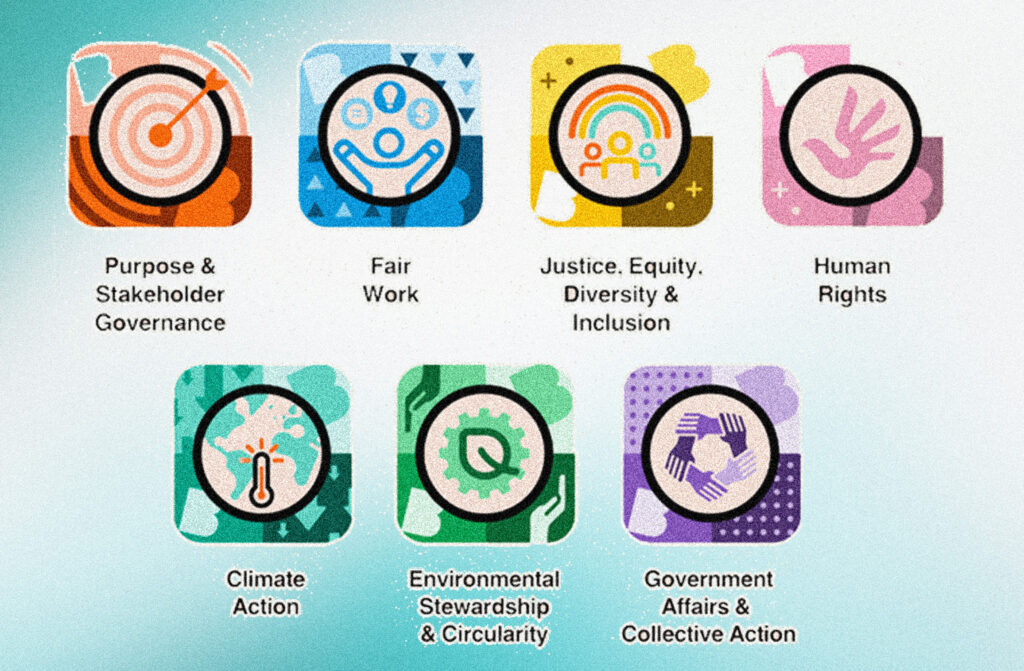
Instead of optimizing for points, companies must now meet mandatory performance requirements across seven impact topics, including governance, climate action, human rights, and fair work. (See below for explanation of each). The specific requirements vary depending on a company’s size, sector, and geographic context.
This shift ensures that certified companies demonstrate balanced performance across all core impact areas, rather than excelling in only a few.
In practice, certification becomes less about maximizing a score and more about building the systems, policies, and processes needed to manage impact consistently across the business.
INDEPENDENT THIRD-PARTY VERIFICATION
Alongside the shift to mandatory performance thresholds, V2.1 introduces a stronger role for independent third-party assurance providers.
Verification becomes more aligned with formal audit processes, with clearer documentation and evidence requirements. This increases the credibility of certification and reinforces trust among investors, customers, and regulators.
For companies preparing for (re)certification, this means systems and documentation should be structured and audit-ready.
KEY DATES (2026)
The transition timeline is now active.
January 2026
Recertification under V2.1 began.
March 2026
All new certifications now follow V2.1.
September 2026 (EU context)
Organizations affected by the Empowering Consumers for the Green Transition (ECGT) Directive are strongly encouraged to certify under V2.1 to align with European sustainability claim requirements.
If your recertification falls in 2026 or 2027, preparation should already be in motion.
RECERTIFICATION UNDER V2.1: START 18 MONTHS BEFORE YOUR DEADLINE
Preparation ideally begins 18 months in advance:
- Months 1–3: Conduct a gap assessment and prioritize actions
- Months 4–12: Implement improvements across governance, climate, HR, and supply chains
- Months 13–18: Finalize documentation and prepare for verification
Early preparation allows improvements to integrate into strategy rather than becoming last-minute compliance work.
FOUNDATION REQUIREMENTS: THE NEW STARTING POINT
Before progressing to the seven Impact Topics, companies must first meet Foundation Requirements.
These include:
- Legal and operational eligibility: The company must be legally incorporated, operating for at least 12 months, compliant with laws, transparent, and aligned with B Lab’s Theory of Change.
- Stakeholder governance: Companies must formally adopt a stakeholder governance model and embed stakeholder consideration into legal structures.
- Risk profiling: Organizations must submit a risk profile and comply with additional requirements triggered by industry or operational risk exposure.
This creates a structured gateway before performance topics are even assessed. Governance alignment now happens earlier and more formally in the process.
THE 7 IMPACT TOPICS UNDER V2.1
Once Foundation Requirements are met, companies demonstrate measurable action across seven core areas. (Read B Lab’s full press release here).
1. Purpose & Stakeholder Governance
Purpose must be clearly defined and integrated into governance and decision-making. Companies implement grievance mechanisms, responsible marketing practices, transparency commitments, and leadership oversight of impact performance.

2. Fair Work
Organizations are expected to create quality jobs and positive workplace cultures, supported by fair employment practices, clear policies, and employee engagement.
Example:
A company implements a living wage policy, introduces regular employee feedback surveys, and establishes a training budget for all employees.

3. Justice, Equity, Diversity & Inclusion (JEDI)
Companies must actively build inclusive and equitable workplaces, supported by measurable actions that promote diversity and equal opportunity.
Example:
A company tracks gender and diversity representation in leadership positions and sets measurable targets to improve representation over time.

4. Human Rights
Businesses must identify and address human rights risks across their operations and value chain, ensuring that people are treated with dignity and respect.
Example:
A company maps its supply chain and requires key suppliers to comply with a code of conduct covering labor rights and working conditions.

5. Climate Action
Scope 1, 2, and 3 emissions measurement becomes standard. Companies align commitments with 1.5°C pathways and implement credible climate action plans with documented progress.
6. Environmental Stewardship & Circularity
Organizations must manage environmental impacts responsibly and move toward more circular use of resources, reducing harm while improving resource efficiency.
Example:
A company redesigns its packaging to eliminate single-use plastics and introduces a product repair program to extend product life.

7. Government Affairs & Collective Action
Responsible lobbying, transparent tax practices, and engagement in collective social or environmental initiatives are formalized.
Example:
A company publishes its lobbying positions and joins an industry coalition advocating for stronger climate policy.

IN A NUTSHELL: WHAT SHOULD ENTERPRISES PREPARE FOR?
The new B Corp standards require companies to move beyond individual sustainability initiatives and build structured impact management systems across their organization.
In practice, enterprises should prepare for five major shifts:
Companies must embed stakeholder considerations into governance and decision-making, often requiring legal adjustments and stronger leadership oversight.
Sustainability practices must be supported by documented policies, internal processes, and accountability structures across topics such as HR, environment, and supply chain management.
Organizations will need to identify and manage risks related to human rights, environmental impact, and business practices across their operations and supply chains.
Companies must measure and monitor their impact through data, for example on climate emissions, workforce practices, and environmental performance.
Certification will involve stronger verification and more public transparency, requiring companies to maintain clear documentation and evidence of their practices.
READY TO EXPLORE WHAT THIS MEANS FOR YOUR ORGANIZATION?
We help you:
- Prepare for (re)certification under V2.1
- Translate the standards into a clear transition roadmap
- Develop policies, action plans, and structured documentation
- Align B Corp with ESG or CSRD strategy
We’d be happy to discuss your next steps.
B-Boosters, Powered by The Overview Effect.